
Creative writing and reluctant writers. Those two just don’t seem to go together well, do they? While teaching creative writing to your reluctant writers may seem like an impossibility, it isn’t. I promise.
Before a child is ready to take on creative writing, they need to learn and practice certain writing skills.
The littlest learners will begin with their ABCs, followed by learning to read and write words and sentences and then come spelling and grammar lessons.
Those aren’t the only skills they will learn regarding writing; however, they will also need to learn how to proofread, edit and find their own writing style and voice. The last two are the writing skills that will take the most time to learn.
Creative writing isn’t a black-and-white process. It takes time to color in between the lines.
Learning how to weave the perfect words into a story that creates a picture you can walk into doesn’t happen with the first scratch of your pen on paper or keystroke.
How to Teach Creative Writing to Reluctant Writers
So, all that being said. How do you teach creative writing to reluctant writers, kids that don’t naturally want to sit down and not only write the world a story, but hold every reader captive while doing so?
- First? Don’t start too early.
If you love homeschool curricula as much as I do, you’ll find that most creative writing programs begin during the middle school years. There are specific, important reasons for this!
Creative writing requires the ability to express yourself. This isn’t a skill that young children are typically ready for or able to do well.
Feelings, emotions, life experience and judgment skills simply are too much for most elementary students to process, let alone write about.
- Next? Give them time.
When it comes to homeschooling our children, oftentimes, we have a set schedule to meet. Whether it is a timeframe we’ve placed on ourselves, an umbrella school’s criteria or a state’s requirement.
Writing is both an art and a skill. It doesn’t just happen like arithmetic, where 1+1=2 and 3×3=9 every single time. With numbers, you sit down and complete the equation based on the rules of mathematics. Creative writing is creative; it doesn’t have a list of rules aside from grammar.
While there are writing assignments that our children will need to complete within a specific time frame, creative writing is not one of them, in my opinion.
- Finally? Don’t critique too much.
The quickest way to deflate a child who is attempting to write when they don’t like it to begin with is to be too critical.
There will be instructions and edits that you will need to give and point out. Be sure to focus on them actually writing and encourage them more than anything else.
If you enjoy writing, consider a skill or task that you don’t particularly enjoy completing. Be diligent to keep that squarely in mind when discussing your reluctant writer’s paper or story.
Reluctant writers can make creative writing difficult to teach. Thankfully, you don’t have to teach them on your own.
As with any subject, there are amazing creative writing curricula and resources available to help both you and your students on your homeschooling journey.
Over the years, I’ve used many different writing courses myself and with my kids, including Wordsmith by Janie B. Cheaney.
The Wordsmith creative writing course does an amazing job building on the writing skills you’ve taught your children through elementary school!
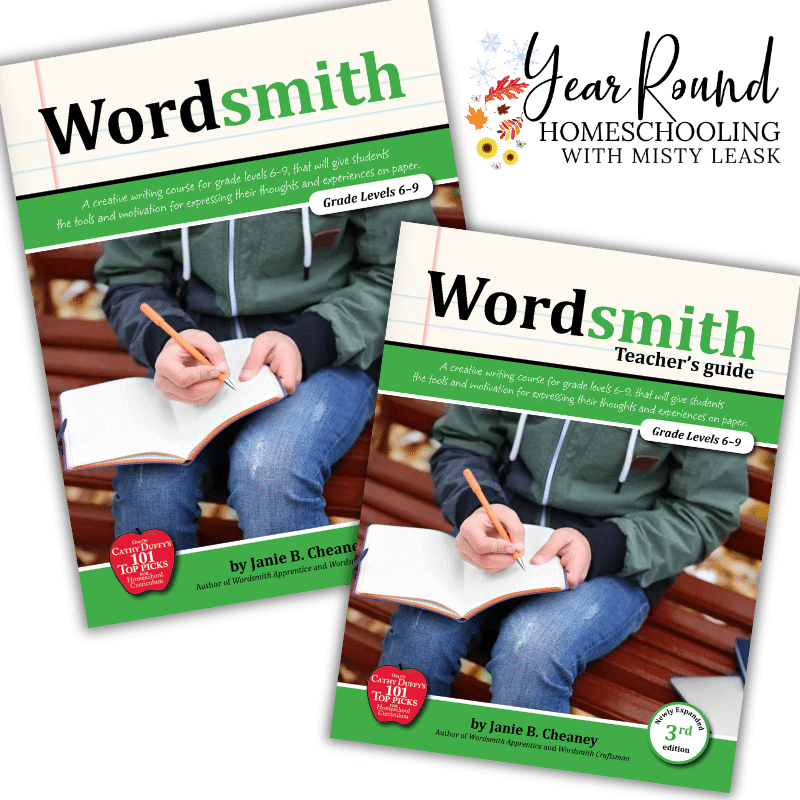
About the Wordsmith Student Book
The first entry in the student book will catch your reluctant writer’s attention right off the bat.
‘So you think you hate writing’.
Throughout the first section of the course, your student will continue to learn more about the parts of speech. Each lesson includes several exercises to be completed and proofreading, extra practice and ‘just for fun’. For students who need or prefer to see examples of the exercises, those are included in each lesson as well.
The second portion covers the skill of building strong sentences. The lessons included here will require your students to often rewrite dull and boring sentences, making them more creative and exciting.
The third and final part of this course teaches how to take the above writing skills and put them together and actually start writing. They’ll work on using their senses as part of their writing, the importance of sequence and details, as well as point of view and more!
After each section of the course, there is a review in the back of the student’s book for them to complete, if you’d like to see how well they’re remembering the lessons as they go.
About the Wordsmith Teacher’s Guide
I don’t always read through a teacher’s guide or manual, but I will admit to thoroughly enjoying this one. It is apparent that the author, Janie B. Cheaney, is a skilled writer with the ability to catch and keep the reader’s attention – even in a teacher’s guide.
To begin with, she tells you right away what this book will not do, followed by her view of a K-12 writing curriculum and what the book was designed to do.
You’ll find a suggested study plan to complete this curriculum in 36 weeks. There are recommended resources, details regarding the daily lessons, as well as teaching prompts included in this section of the teacher’s guide.
As creative writing is not a subject for which you can create a grading chart because each student’s writing is unique, thus the only grading tools provided are for the review quizzes.
This resource a great start for students needing to build their creative writing skills, but keep in mind, it is for creative writing. It is not designed for nor does it include comprehensive grammar lessons, how to write book reports or research papers, etc. as those do not fall in the creative writing criteria.
If you’re looking for an affordable, easy-to-use creative writing course for your reluctant writing middle schoolers, this may be just what you’re looking for!
A few important things to remember…
The written word takes time to create.
It takes time to learn your voice.
Writing requires your mind and your heart.
The best writers in the world, whether fiction or non-fiction, move you emotionally, mentally, spiritually and at times even physically.
Don’t rush your children as they develop their creative writing skills. Remember, it is an art and an artist’s masterpiece is worth all the time they need to complete it.
**Please note resources mentioned in this post may have been received for free or I may have received monetary compensation to write this post. However, the reviews are my personal opinion. For more information, please see my disclosure page.*
